
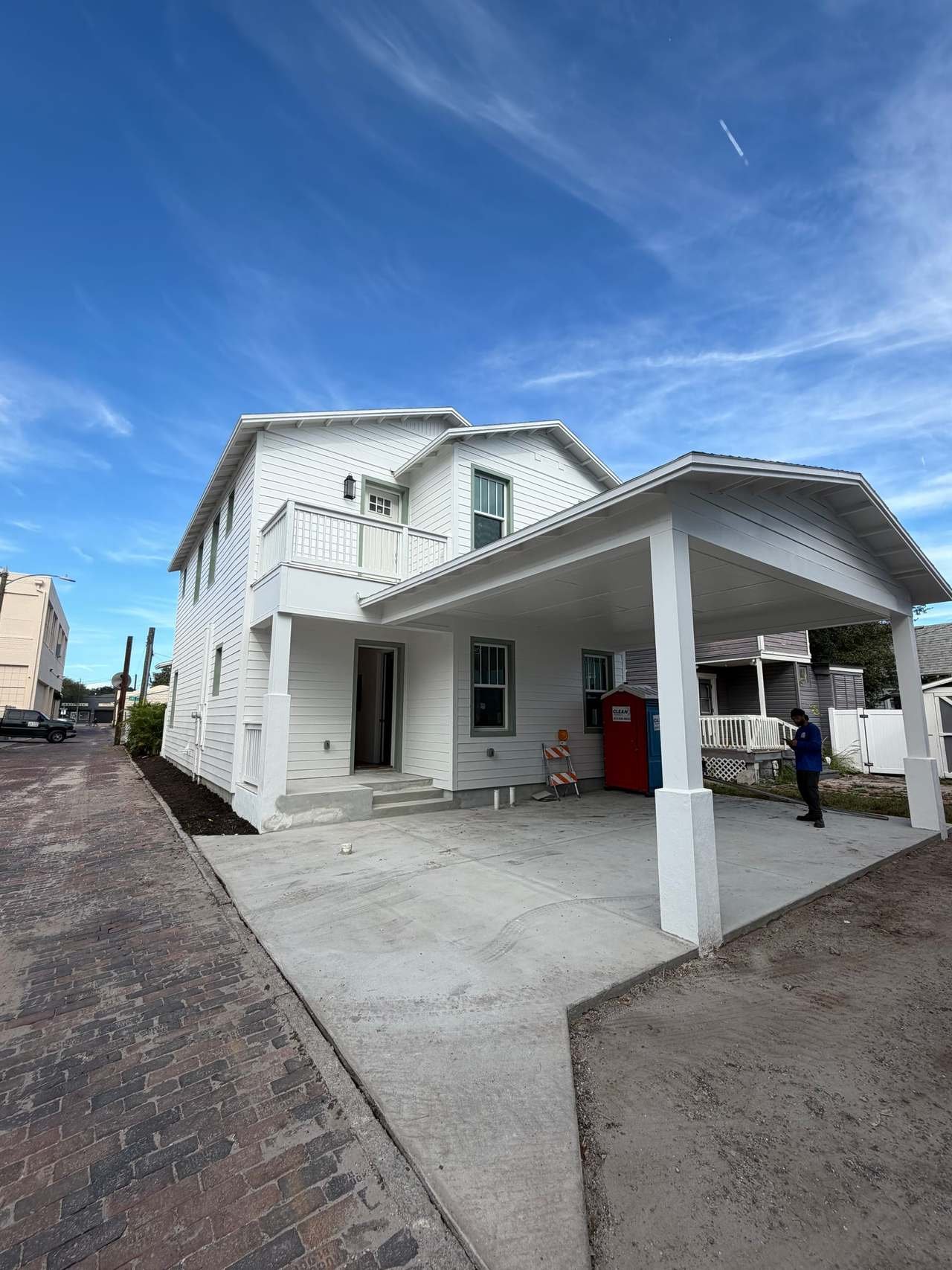
ADU rules in Florida: what Tampa Bay homeowners can build in 2026
ADU rules in Florida for 2026, compared for Tampa, St. Pete and Pinellas, Pasco and Hillsborough counties: size caps, parking, occupancy, cost.
Last reviewed November 2026
ADU rules in Florida are set city by city and county by county. State law lets local governments allow accessory dwelling units in single-family neighborhoods but, as of November 2026, doesn’t require them to. So whether you can build a garage apartment, a backyard cottage or a suite with its own kitchen depends on exactly where your lot is in Tampa Bay.
This guide compares the rules we could confirm from official sources for the City of Tampa, St. Petersburg, and Pinellas, Pasco and Hillsborough counties, and explains what an ADU typically costs to build here.
What counts as an ADU in Florida
Florida’s statute defines an accessory dwelling unit as a unit with its own kitchen, bathroom and sleeping area, located in the same building as the main home or on the same lot (s. 163.31771, Florida Statutes). In everyday terms, that includes:
- A garage apartment, above or beside a detached garage
- A detached backyard unit
- An attached suite with its own kitchen and entrance
- A converted garage with a kitchen, bath and entrance
The kitchen is usually what makes something an ADU. An in-law suite with a kitchenette may or may not be classified as a separate dwelling, depending on local rules, and that classification affects what you can build.
Did Florida’s ADU law change in 2026?
You may have seen headlines about a statewide ADU mandate. Here’s where it landed:
- SB 48 (2026) would have required every city and county to adopt an ordinance allowing ADUs in single-family zones. It passed the Senate unanimously but died when the House didn’t take it up (bill history).
- HB 1389 (2026), the affordable housing bill that did pass and became Chapter 2026-179, deals with multifamily and mixed-use housing. Its official bill summary doesn’t mention ADUs (bill history).
- The 2026 version of s. 163.31771 still says a local government may allow ADUs.
So the local rules below are what matter for now. If the Legislature takes up ADUs again, that could change.
ADU rules around Tampa Bay, compared
| Jurisdiction | Where allowed | Max size | Owner on site? | Parking |
|---|---|---|---|---|
| City of Tampa | Designated ADU areas (others: family-only “Extended Family Residences”) | 950 sq ft (general standards) | Yes, in either unit | 1 space per unit |
| City of St. Petersburg | NT lots of 4,500+ sq ft; NS lots of 10,000+ sq ft or on an alley or corner | 800 sq ft or 67% of the home, whichever is less | Not required | 1 extra space |
| Unincorporated Pinellas | Per county zoning standards for your district | 1,000 sq ft (750 in coastal storm and flood hazard areas) | Yes, unless both units are qualifying affordable rentals | Per county code |
| Unincorporated Pasco | Districts that allow single-family homes, and many MPUDs | 1,200 sq ft, and smaller than the main house | Not required | On site, unless on-street parking is allowed |
| Unincorporated Hillsborough | Ask the county | Ask the county | Ask the county | Ask the county |
City of Tampa
The city allows ADUs in Seminole Heights, the area around Lowry Park, the East Tampa Overlay and the Tampa Heights Overlay, and it expanded the eligible area in 2024. Everywhere else in the city, a second unit can be built only for a family member, as an Extended Family Residence with its own requirements. The city’s ADU page links to a map that shows whether your parcel qualifies.
The city’s general ADU standards (which don’t apply in neighborhood overlay or historic districts; those have their own guides) set a 950-square-foot maximum, one parking space per unit, a maximum occupancy of two unrelated adults, and a requirement that the owner live on the property. In 2024 the city dropped the rule that the owner had to live in the main house, so the owner can live in either unit. A separate utility meter is permitted. You may see a smaller size cap quoted elsewhere; check the guide for your specific district. The city lists 813-274-3100 for zoning and permit questions.
City of St. Petersburg
According to the city’s ADU page, lots zoned NT must be at least 4,500 square feet, and lots zoned NS at least 10,000 square feet or on an alley or corner. The ADU can be up to 800 square feet or 67% of the existing home, whichever is less, and needs an extra parking space. The main home doesn’t have to be owner-occupied, but if both units are rented, you need a Business Tax Certificate. Zoning questions go to DevRev@stpete.org.
Unincorporated Pinellas County
Pinellas County’s 2024 ADU update raised the maximum size from 750 to 1,000 square feet, except in the Coastal Storm Area and other flood hazard areas, which stay at 750. A garage or storage space serving the ADU counts toward its size. The county waived development review fees for ADUs, and it waives owner occupancy only for affordable units under a 20-year agreement.
The county also offers a property tax break when a parent or grandparent aged 62 or older lives in the ADU as their primary residence. Ask the Property Appraiser about eligibility. Cities in Pinellas, such as Clearwater, Largo and Dunedin, set their own ADU rules.
Unincorporated Pasco County
Pasco’s ADU page allows ADUs in zoning districts that allow single-family homes, up to 1,200 square feet and smaller than the main house. Owner occupancy isn’t required, parking must be on site unless on-street parking is allowed, and you submit an affidavit for each ADU. Impact and mobility fees can apply, and the county offers a request form to estimate them in advance.
Unincorporated Hillsborough County
We couldn’t confirm the county’s current ADU size, lot and occupancy standards from an official county page, and third-party summaries disagree. If your home is in Brandon, Riverview, Carrollwood, Valrico or another unincorporated area, ask Hillsborough County Development Services at (813) 272-5600 before you design.
What else decides whether you can build
- Setbacks and lot coverage. A detached unit has to fit within the setbacks for accessory buildings on your lot.
- Flood zone. An ADU in a flood hazard area must be built at the required elevation, and in unincorporated Pinellas it’s capped at 750 square feet. See our post on the FEMA 50% rule.
- HOA covenants. These can prohibit ADUs even where zoning allows them.
- Utilities. Water, sewer or septic capacity, and electrical service, can add real cost.
- The building code. An ADU is a dwelling: wind-rated structure, energy code, egress, smoke alarms and fire separation where it attaches to a garage or the house.
What an ADU costs in Tampa Bay
These are typical late-2026 ranges, not quotes. Costs per square foot run higher for small units, because the kitchen, bathroom, utilities, permits and engineering cost nearly the same whether the unit is 400 or 900 square feet.
| Type of ADU | Typical range |
|---|---|
| Garage conversion into an ADU (kitchen, bath, entrance) | $95,000 to $160,000 |
| Attached suite built as an addition | $120,000 to $250,000 |
| Garage apartment or detached unit, new construction | $150,000 to $300,000 and up |
The biggest swing factors are size, new utility connections, impact fees, flood elevation, the foundation, impact windows and doors, and the finish level of the kitchen and bath. Our garage conversion cost guide breaks down one option in more detail.
How we help
We build three of the most common ADU-style projects in Tampa Bay: detached garages with apartments, in-law suite additions and garage conversions. On the first visit we check what your city or county allows on your specific lot, then give you a fixed-price proposal for the option that fits. If you’re still deciding how to add space, our room additions page covers the alternatives.
Common questionsQuestions
Does Florida law require cities to allow ADUs?
Not as of November 2026. Florida's ADU statute (s. 163.31771) says a local government may allow accessory dwelling units in single-family zones, but it doesn't require it. A 2026 bill that would have required every city and county to allow them passed the Senate but died in the House.
How big can an ADU be in Tampa?
The City of Tampa's general ADU standards set a maximum of 950 square feet, with one parking space per unit, in areas where ADUs are allowed. Neighborhood overlay and historic districts have their own guides, so check the city's ADU page and map for your lot.
Do I have to live on the property to build an ADU?
It depends on where you live. The City of Tampa requires the owner to live on the property, in either the main home or the ADU. St. Petersburg says the main home doesn't have to be owner-occupied. Unincorporated Pinellas waives owner occupancy only for qualifying affordable rentals. Pasco County says owner occupancy is not required.
Can I turn my garage into an ADU?
Often, yes, if your zoning allows ADUs and the converted space meets the size, parking and building code rules. A garage conversion with its own kitchen, bathroom and entrance is usually treated as an ADU, while one without a kitchen is usually just more space for the main house.
Can my HOA stop me from building an ADU?
It can. Deed restrictions and HOA covenants are private rules that can limit or prohibit ADUs even where the city or county allows them. Read your covenants before you design.